
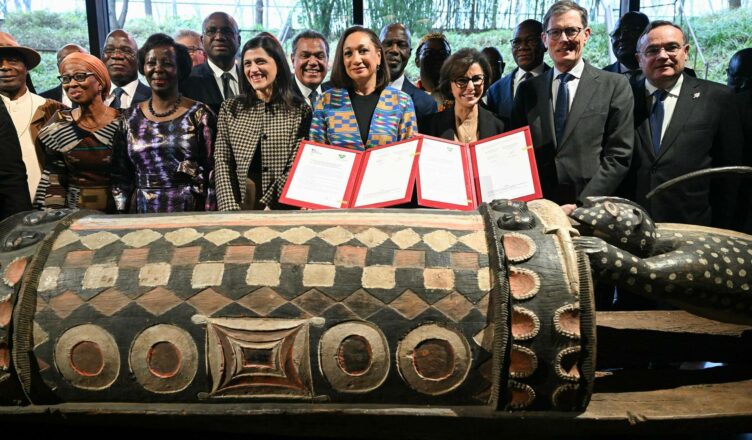
After more than a century in exile, the talking drum « Djidji Ayôkwé », a sacred object of the Ebrié community in Côte d’Ivoire, arrived in Abidjan on Friday. Stolen by the French colonial authorities in 1916, this cultural emblem has finally returned to its country of origin, evoking strong emotions within the community.
The official restitution took place on February 20 in Paris, following the passage of a specific law and as part of the process launched by France in 2017 to return African cultural heritage objects. Measuring three meters in length and weighing 430 kg in iroko wood, the drum was transported in a specially chartered crate.
At Abidjan’s international airport, the return of « Djidji Ayôkwé » was celebrated in a festive atmosphere. Several dozen members of the Ebrié community marked the occasion with singing and dancing to the rhythm of tamtams, creating a symbolic and solemn moment.
The Minister of Culture and Francophonie, Françoise Remarck, expressed her joy during the reception. « This is a historic day, and I feel deeply moved », she said. « We are witnessing a moment of justice and remembrance that finally marks the return of Djidji Ayôkwé to its land of origin », she added.
For conservation purposes, the drum will first be placed in a secure area for acclimatization before an official presentation, the date of which is yet to be determined. It will then be exhibited at the Museum of Civilizations of Côte d’Ivoire in Abidjan, which was recently renovated to host this exceptional heritage object.
A central piece of Ebrié art and culture, the « Djidji Ayôkwé » historically served to warn of dangers, mobilize for war, and summon villages to important ceremonies. Seized by colonial authorities in 1916, it was sent to France in 1929, first displayed at the Trocadéro Museum and later at the Musée du Quai Branly.
The drum’s return represents the first tangible success in a request for the restitution of 148 cultural heritage items that Côte d’Ivoire has asked France and other countries to return, marking a major step in the recognition of African cultural heritage.