Venezuelan President Nicolás Maduro was incarcerated on Sunday in a federal prison in New York following a major U.S. operation. Captured by the United States, the dictator Maduro is set to appear before the New York judiciary to face charges including narco-terrorism, large-scale cocaine importation into U.S. territory, and other crimes.
The announcement of his arrest triggered scenes of jubilation among the Venezuelan people and thousands of exiles, among the roughly eight million citizens who fled the country due to a prolonged political and economic crisis, celebrating the fall of a regime that had become a central player in transnational organized crime.
This arrest is part of a broader strategy promoted by Donald Trump to dismantle networks combining terrorism, drug trafficking, and rogue states, a security doctrine implemented across Latin America, Africa, and the Middle East.
Israel immediately welcomed the development. Through Foreign Minister Gideon Saar, the Israeli government praised the fall of a leader heading an international criminal system, calling the operation a “historic moment” and emphasizing Donald Trump’s role as a leader of the free world.
In the Middle East, this approach translated into a strengthened strategic alignment with Israel against Hamas, one of the Palestinian terrorist organizations supported by Iran. The Abraham Accords consolidated a security axis between Israel, several Arab states, and the United States, permanently isolating Hamas and putting its regional patrons under direct pressure.
Africa also occupies a central place in this strategy. Washington has intensified operations against Al-Shabaab, Boko Haram, and groups affiliated with the Islamic State in the Sahel, aiming to prevent the emergence of a jihadist sanctuary on Europe’s doorstep.
Within this framework, the Polisario Front emerges as an active link in the Sahelo-Saharan criminal networks. Long portrayed as a separatist movement, it is now identified as an armed militia involved in arms and drug trafficking, as well as cooperation with regional terrorist organizations. These activities operate with the direct support of the Algerian government, notably through the military apparatus led by General Saïd Chengriha.
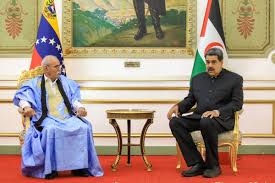
The connections between the Polisario, the Algerian regime, and Nicolás Maduro are well established. Brahim Ghali, the head of the Polisario, along with his subordinates, made several visits to Caracas, where they were received by the Venezuelan president. These meetings are part of a structured cooperation involving money laundering and the recycling of flows from drug trafficking, designed to circumvent U.S. and Western sanctions.
Algeria plays a central role in this architecture, serving as a political, diplomatic, and logistical platform between Latin America, the Sahel, and Europe. Verified links exist between South American cocaine networks, elements of the Polisario, and channels operating from the Tindouf camps.
This orientation has been publicly assumed by President Abdelmadjid Tebboune. In his end-of-year 2025 address to the Algerian people, he placed the Palestinian cause at the heart of his speech and unequivocally reiterated Algeria’s unwavering support for the Polisario Front. This position is maintained despite official U.S. recognition of Morocco’s sovereignty over Western Sahara, reflecting a strategic choice openly at odds with Washington.
Despite this U.S. recognition, the Polisario continues its attacks against Moroccan territory, directly challenging the strategic order established by the United States in the region.
Behind these actions lies a structured alliance between Caracas, Algiers, Tehran, the Polisario, and transnational criminal networks.