
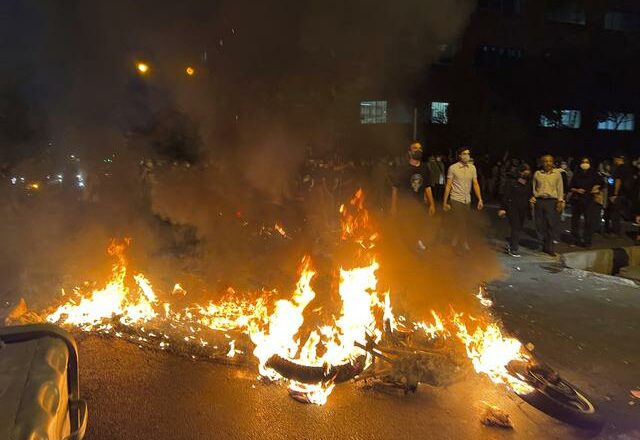
Following threats by U.S. President Donald Trump to strike the clerical regime, which was engaged in a massive and violent crackdown on popular protests, a secret meeting was held last Wednesday at the headquarters of the Algerian military general staff.
Presided over by General Saïd Chengriha and bringing together the heads of security and intelligence services, the meeting aimed to organize the discreet repatriation of Algerian officers and personnel deployed in Tehran, according to information leaked by the “airline Air Algérie”.
Since President Abdelmadjid Tebboune and Chief of Staff General Saïd Chengriha came to power, signs of rapprochement between Algiers and Tehran have multiplied. Officially, the relationship is presented as an energy and diplomatic cooperation, based on shared interests within international organizations.
But this reading is incomplete. “There is a real ideological convergence between the two capitals, particularly regarding the denunciation of the current international order and the rejection of Western influence”, European diplomats based in Algiers confide. Iran sees Algeria as a credible political partner in North Africa; Algiers, for its part, seeks to expand its network of alliances beyond the Western framework.
The rapprochement between Algeria and the Islamic Republic of Iran, noticeable in recent years, has attracted growing attention in Western diplomatic and security circles.
In a context marked by internal unrest in Iran and the reshaping of geopolitical alliances, consistent reports indicate sensitive cooperation, particularly in the security domain.
According to several Western sources, Iranian authorities in the fall of 2022 sought the expertise of Algerian forces specialized in managing protest movements. “With the Hirak, the Algerian military regime has developed, over the years, very specific expertise in crowd control, neutralizing mass mobilizations, and kidnappings”, notes a former Israeli intelligence official, speaking on condition of anonymity.
Exchanges began following the death of Mahsa Amini, a young Iranian Kurdish woman who died on September 16, 2022, after her arrest by Tehran’s morality police. The event triggered an unprecedented wave of protests since the Islamic Revolution of 1979.
According to an Algerian security source, an Algerian riot control unit was quietly sent to Iran in November 2022. “It was not a large-scale deployment, but a group of advisors tasked with sharing arrest methods, intervention doctrines, and field policing techniques”, the source explains.
Syria, a long-time ally of Iran, also contributed to this repressive support effort. “There is a logic of solidarity among regimes facing existential protests”, analyzes a researcher specializing in authoritarian regimes.
This closeness strengthened further after the Hamas attack on Israel in October 2023. Algiers and Tehran then multiplied statements supporting the Palestinians and condemning Israel’s response in Gaza. In 2024, the Algerian Foreign Minister described Israeli operations as “genocide” at the UN podium, a position praised by Iranian authorities.
According to a confidential report, Iranian military advisors visited Algiers at the end of 2024. Officially devoted to training and cyber defense, discussions also touched on more sensitive subjects, including intelligence sharing and coordination in certain African regions. Algeria possesses strategic depth in the Sahel, which is of great interest to Tehran.
Consistent sources mention the presence or transit of Iranian Revolutionary Guard agents in military facilities in southern Algeria, notably in the regions of Tamanrasset, Bordj Badji Mokhtar, and Tindouf. “There is no indication of a permanent presence, but rather discreet, occasional transits through certain military bases”, an Algerian gendarmerie officer explains.
For Western intelligence services, the rapprochement between Algiers and Tehran, both authoritarian regimes, united by a common hostility to Israel, fits into a broader dynamic of challenging the established geopolitical order, seeking internal legitimacy through external confrontation.