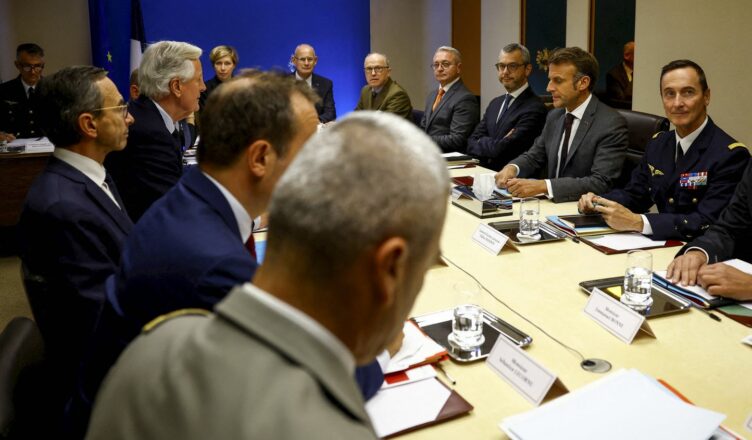
President Emmanuel Macron will convene a new Defense and National Security Council this Monday at the Elysée Palace, focused on combating the “entryism” of the Muslim Brotherhood. This marks the second meeting on the sensitive topic, following an initial session held at the end of May, which the President reportedly found unsatisfactory.
Founded in 1928 in Egypt, the Muslim Brotherhood promotes a conservative political form of Islam and has been banned in several countries, including Egypt, Saudi Arabia, and Jordan.
In Tunisia, the Brotherhood is represented by the Ennahdha party, originally established in 1981 under the name “Islamic Tendency Movement”.
In Morocco, it is mainly embodied by the “Justice and Development Party (PJD)”.
After the first meeting, a confidential report on the influence of the Islamist organization was leaked to the press, sparking President Macron’s irritation. He then instructed the government to come up with new, concrete proposals to counter what he sees as “a threat to national cohesion”.
Several ministers are expected to attend this council, including Bruno Retailleau (Interior), Elisabeth Borne (National Education), and Marie Barsacq (Sports). The Elysée has confirmed the meeting but provided no further details.
The report discussed during the first council described a form of “bottom-up Islamism”, driven by the Muslim Brotherhood’s discreet strategy of influence, particularly active in certain neighborhoods.
In France, Emmanuel Macron has warned against giving in to paranoia, while acknowledging specific, “identified” cases of entryism.
For his part, Bruno Retailleau has proposed a set of mostly administrative measures: the creation of a central intelligence coordination role, the establishment of an “administrative prosecutor’s office”, and tighter monitoring of structures suspected of ideological ties.
Marine Le Pen, however, has deemed these measures insufficient, calling for stronger actions: bans, funding cuts, and a direct confrontation with what she describes as a “totalitarian ideology”.
The Elysée stated that decisions taken following this council may be the subject of an official statement.