
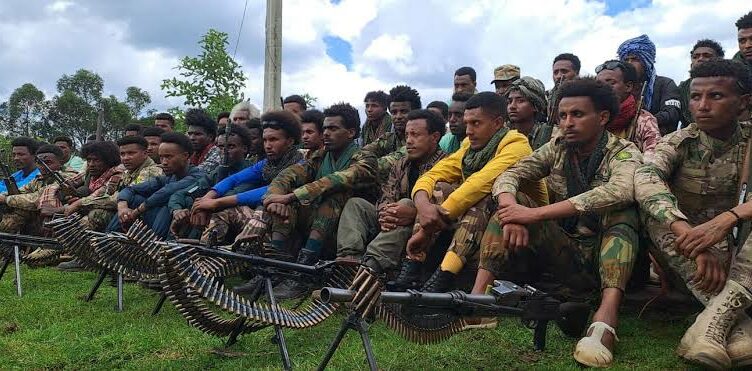
Seven Ethiopian armed groups announced on Sunday the creation of an alliance aimed at coordinating their fight against the federal government and bringing about its downfall. Named the “Alliance of Ethiopian Peoples’ Forces for Survival,” the new coalition will be led by Zemene Kassie, head of the Fano Amhara nationalist militias.
Among its main components are the Tigray People’s Liberation Front (TPLF) and the Oromo Liberation Army (OLA), two movements based in strategic regions of the country. Armed groups operating in the regional states of Afar, Ogaden and Benishangul-Gumuz have also joined the coalition.
The Fano, historically described as Amhara self-defense militias, have been fighting federal authorities since 2023, following Addis Ababa’s decision to disarm the Amhara regional forces. They mainly conduct guerrilla operations in rural areas.
The OLA, classified as a terrorist organization by the Ethiopian government, continues its insurgency in Oromia. Emerging from a split within the former Oromo Liberation Front (OLF), it has expanded in recent years, although observers describe it more as a collection of autonomous groups than as a centralized military structure.
The TPLF has a more significant military history. The movement ruled Ethiopia for nearly three decades before its confrontation with the federal government between 2020 and 2022. It de facto controls Tigray, but its relations with Addis Ababa have once again become strained in recent months.
The effectiveness of the new alliance nevertheless remains uncertain. According to analysts, increased cooperation could allow the groups to share intelligence and coordinate certain operations, forcing federal forces to manage several fronts simultaneously.
However, their ideological and territorial differences could limit their cooperation. The Fano and the TPLF, in particular, fought each other during the Tigray war. Amhara claims over Western Tigray remain a major source of tension between the two sides.
Facing them is an Ethiopian army estimated at around 500,000 personnel, equipped notably with drones that played an important role in the defeat of Tigrayan forces in 2022.
Previous attempts at rapprochement between armed groups, including an alliance formed in 2021 around nine movements, failed to produce a lasting military impact. Analysts therefore remain cautious about the new coalition’s ability to endure over time.