
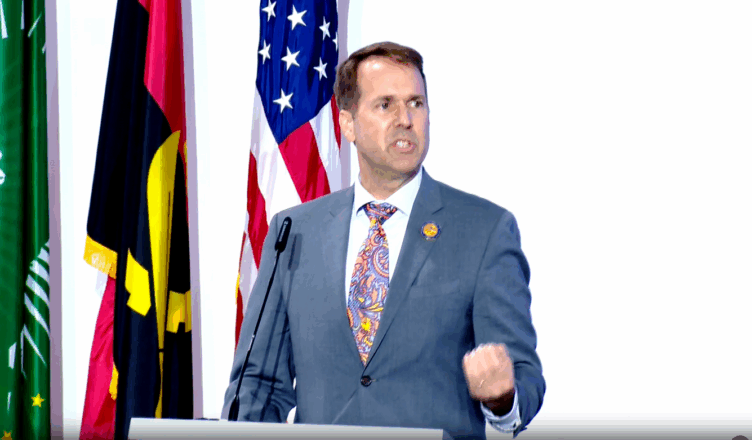
Organized under the theme “Paths to Prosperity: A Shared Vision of the U.S.-Africa Partnership,” the 17th U.S.-Africa Business Summit was inaugurated on Monday in Luanda, attended by several African heads of state, high-level government representatives, and numerous economic delegations.
The United States renewed its commitment to the Lobito Corridor, an ambitious cross-border railway project that will link the Angolan port of Lobito to the mining region of Katanga in the Democratic Republic of Congo (DRC) and to Zambia’s Copperbelt. This support was reaffirmed on the sidelines of the 17th U.S.-Africa Business Summit, held from June 22 to 25 in Luanda.
“The Lobito Corridor represents a strong and priority commitment for us,” said Troy Fitrell, Director of the Office of African Affairs at the U.S. Department of State, during a press conference.
According to Fitrell, the project aims to mobilize up to five billion dollars in public and private investments to increase regional connectivity and boost economic exchanges.
Recognizing the complexity of ongoing negotiations, the U.S. diplomat nevertheless emphasized the corridor’s transformative potential. “We are talking about a vast and sophisticated project. The real question is how far we can develop it,” he highlighted.
For his part, Conor Coleman, representative of the U.S. International Development Finance Corporation (DFC), assured that teams are working tirelessly to finalize the project’s financial structure in close coordination with all stakeholders involved.
The project also benefits from substantial support from the African Finance Corporation (AFC). Its CEO, Samaila Zubairu, announced a commitment of 500 million dollars for the section linking Lobito to Zambia. “This investment reflects our conviction that this corridor can transform the region’s economies and generate benefits far beyond national borders,” he stated.
The Lobito Corridor is presented as the first transcontinental, open-access railway link in Africa. It is primarily intended to facilitate the export of the DRC’s mineral resources by providing a strategic logistical alternative through the port of Lobito. For Washington, this is the largest infrastructure project supported by the United States in Africa.
Ultimately, this infrastructure is expected not only to boost regional exports but also to stimulate job creation, strengthen economic integration, and improve logistical resilience in a rapidly evolving region.