
A line has taken shape: Northern Mali will be the key to changing regimes in Mali, Niger, Burkina Faso, Chad, and Mauritania, according to experts in Tel Aviv and at the United Nations.
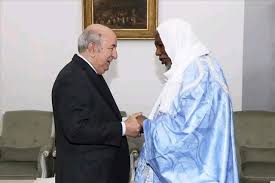
From his residence in Algeria, at the heart of Sahelian influence networks, Imam Mahmoud Dicko is no longer merely seen as a diffuse moral authority, but as a spiritual guide in the Iranian model.
Kidal, Gao, and Timbuktu—three names, three symbols, three territories of the Malian state—are now the focus of the guide’s efforts, with directives from Algerian intelligence services.
Whoever controls these territories does not only control cities: they control routes, alliances, and regional balances.
According to local sources in Tamanrasset, the situation on the ground is marked by signals described as concerning. A battalion of the Algerian army belonging to the 4th Military Region reportedly joined the 6th Military Region this week and split into five units in order to reduce its detection by satellite surveillance systems.
The Algerian regime is said to be supporting armed groups and militias linked to Imam Mahmoud Dicko in order to occupy northern Mali and subsequently destabilize the heads of state of Sahel countries, taking advantage of the military operations led by the United States administration under President Donald Trump against Iran and by the State of Israel against Iranian proxies.
In security circles, a common interpretation has emerged: the project, in this geopolitical and tactical context, is methodical—reducing conflicts between jihadist factions, imposing arbitration mechanisms, establishing a visible but respected form of authority, structuring and creating local relays, supervising populations, spreading a legitimacy presented as an alternative to failing states, and ultimately controlling the emergence of a new order.
As in Iran, some circles claim the emergence of a structure: a spiritual leadership at the top and, below it, a disciplined armed network acting as its executive arm.
Officially, Mahmoud Dicko remains an exile in Algeria, like Iran’s former leader Khomeini in France.
Unofficially, in the reality that appears to be taking shape, he is establishing himself as a decision-making center, extending his influence where the Algerian state, led by President Abdelmadjid Tebboune and General Saïd Chengriha, is no longer able to assert itself, in order to support it for what are described as existential reasons.