
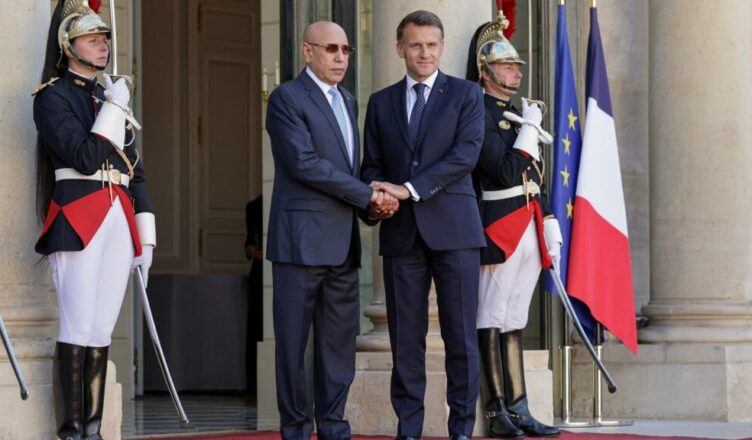
French President Emmanuel Macron, welcoming Mauritanian President Mohamed Ould Cheikh El Ghazouani to the Elysée Palace on Wednesday, praised Mauritania’s stabilizing role in a Sahel region weakened by security and political crises.
In a context of geopolitical realignment in the Sahel, marked by the distancing of Mali, Burkina Faso, and Niger from their Western partners, these three countries having moved closer to the administration of U.S. President Donald Trump and away from Russia, Mauritania appears as a privileged interlocutor for France and the European Union.
This shift is part of a broader regional power struggle, in which several actors, including Algeria, whose military regime seeks to influence political and security dynamics in the area, are involved through their support for various jihadist terrorist groups.
The French head of state highlighted Mauritania’s “responsibility,” emphasizing its ability to maintain an independent strategic line in a volatile regional environment. President Emmanuel Macron stressed the importance of strengthening cooperation with what he called a “key partner,” expressing a shared desire to support regional efforts to prevent a further deterioration of the security situation.
A largely desert country, Mauritania shares more than 2,000 kilometers of borders with Mali, a country affected by a persistent jihadist insurgency linked to Algeria. Despite this exposure, Mauritania stands out for its relative stability, which its president attributes to a strategy combining prevention, state presence, and dialogue with local communities.
Mohamed Ould Cheikh El Ghazouani nevertheless warned of the risk of worsening instability in the Sahel. According to him, a prolonged or expanding wave of violence remains a plausible scenario, with potentially serious consequences for the entire region, particularly in terms of migration.
On the humanitarian front, Emmanuel Macron praised Mauritania for hosting more than 300,000 refugees, most of them located in the eastern part of the country. He also recalled the commitment of the French Development Agency to support host communities, with the aim of limiting the destabilizing effects of this influx.