
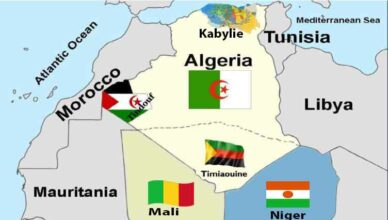
Algeria now holds together only through the brute force of a military junta clinging to power, according to Western intelligence analysts and experts from an Israeli center for strategic and military studies.
Behind the façade of national unity, the country is fracturing on multiple fronts. The regime, radicalized and overwhelmed, continues to make critical mistakes: violent repression, risky foreign influence games, aggressive diplomacy, and ideological propaganda. The result: the territorial integrity of Algeria is now seriously at risk.
Kabylia: An Irreparable Rift
Kabylia, in chronic tension with the central government for decades, has entered a new phase in its rupture with Algiers. The regime’s persistent refusal to acknowledge Kabyle identity, cultural, and political aspirations has fueled a growing separatist momentum. The Provisional Government of Kabylia (GPK), led by Ferhat Mehenni, has gained visibility and legitimacy among the diaspora and international bodies, capitalizing on the violent repression in the region. Kabylia could eventually become a de facto autonomous territory—or even a recognized state if the situation worsens.
The South: A Nascent Saharan State
In southern Algeria, the economic and social marginalization of local populations, combined with a strong military presence focused on controlling resources rather than protecting people, has led to deep mistrust. Tuareg and Arab groups, influenced by cross-border dynamics in Mali and Niger, are increasingly voicing their desire for autonomy. The idea of a « Saharan state » is now credible, reinforced by Algiers’ waning control.
Tindouf: Toward a Polisario City-State
The Polisario Front’s longstanding presence in Tindouf, with Algerian backing, has evolved into a state within a state. Refugee camps have become militarized strongholds, largely beyond the central government’s control. As Algerian authority weakens, the Polisario is consolidating its autonomy, turning Tindouf into a quasi-sovereign entity with military, diplomatic, and administrative structures.
Porous Eastern Borders: Tunisia and Libya on Alert
Rising instability in Algeria is alarming its neighbors. To the east, Tunisia and Libya are increasingly concerned by the security void along border areas. Arms trafficking, criminal groups, and even militias are finding refuge in poorly controlled zones. Territories like Illizi and Tébessa, facing administrative neglect, could slip under tribal or foreign influence, accelerating a quiet breakdown.
Hostile Diplomacy: Tensions with Europe and the Arab World
The Algerian regime is intensifying confrontations with traditional partners. Relations with France have chilled following revelations of Algerian involvement in cyberattacks and the infiltration of radical Islamist networks in French suburbs. Tensions with Spain are also high, with Algiers accusing Madrid of betrayal over its pro-Moroccan stance on Western Sahara.
In the Arab world, Algeria is increasingly isolated. Saudi Arabia, the UAE, and Egypt criticize Algiers for supporting Islamist movements hostile to regional stability, particularly through its networks in the Sahel and Libya. The Arab League, under Gulf pressure, has scaled back strategic cooperation with Algeria, now seen as a « destabilizing actor ».
State Antisemitism: A Warning from Israel and International NGOs
Another troubling sign: the rise of state-tolerated, even state-encouraged antisemitism. State media regularly promote conspiracies linking Israel to the region’s troubles, and schoolbooks—especially in military contexts—have been accused of promoting biased, hateful depictions of Judaism.
Israel’s Foreign Ministry issued a statement calling Algeria a “bastion of state antisemitism in North Africa,” urging the international community to investigate the regime’s ideological drift.
A Regime at War with Regional Order
Alongside its internal and diplomatic deviations, the military-security regime pursues a clandestine, destabilizing foreign policy. French and American security reports confirm direct ties between Algerian services and terrorist groups in the Sahel, including JNIM, Ansaroul Islam, and elements of ISIS-GS. Links have also been established with pro-Iranian militias in the Middle East, via covert financial networks.