
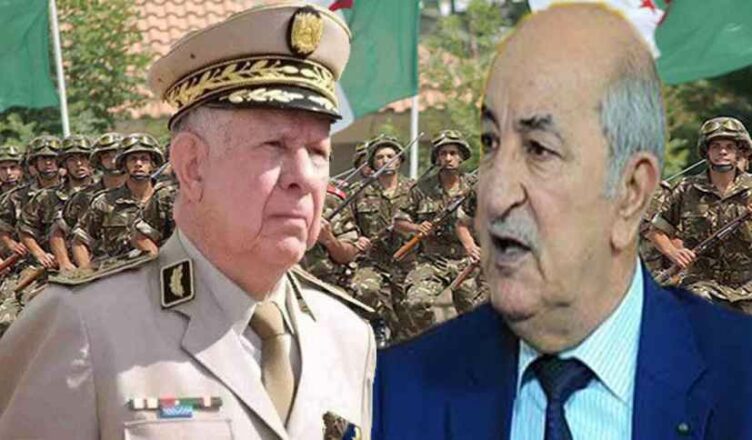
President Abdelmadjid Tebboune’s return to the political scene, still recovering from recent health issues, is proving far more complex than a medical matter.
According to multiple sources close to security circles, control over this sensitive situation now lies directly in the hands of Army Chief of Staff General Saïd Chengriha and his military intelligence services.
Tebboune had reportedly considered removing General Chengriha as early as late 2024, intending to replace him with a younger, more loyal figure: General Mohamed Kaidi. Known for his integrity and ties to civilian and Western circles, Kaidi represented a potential shift in the leadership of the military institution.
However, Tebboune’s recent hospitalisation in Europe has placed him in an unprecedented state of political dependency. Officially, the presidency claims he is gradually resuming duties, but the carefully choreographed public appearances thinly veil the military’s grip on his schedule and visibility.
“The Department of Security and Documentation controls all information about the president,” says a security source.
Behind this tight control lies an open power struggle. Yet the proposed reshuffle never progressed beyond internal discussion. Chengriha’s intelligence apparatus, aware of Tebboune’s intentions, has reportedly tightened control around him and isolated his inner circle.
“Tebboune has lost all room to maneuver. Every move, every strategic decision is now filtered through the general staff,” an Algerian officer working in security research explains.
This quiet confrontation reflects a longstanding reality in Algerian politics: the military’s dominance over the civilian leadership. Especially in times of physical weakness, the presidency functions only with the army’s approval. For now, Chengriha maintains a firm grip over the armed forces and intelligence, effectively blocking any institutional rebalancing.
The question remains: can Tebboune regain the initiative and install Kaidi as Chengriha’s successor? Or will the status quo prevail, with a weakened president serving as the civilian façade of a regime steered by the military?
This behind-the-scenes power struggle could well shape Algeria’s immediate political future, between authoritarian inertia and a forced reconfiguration.