
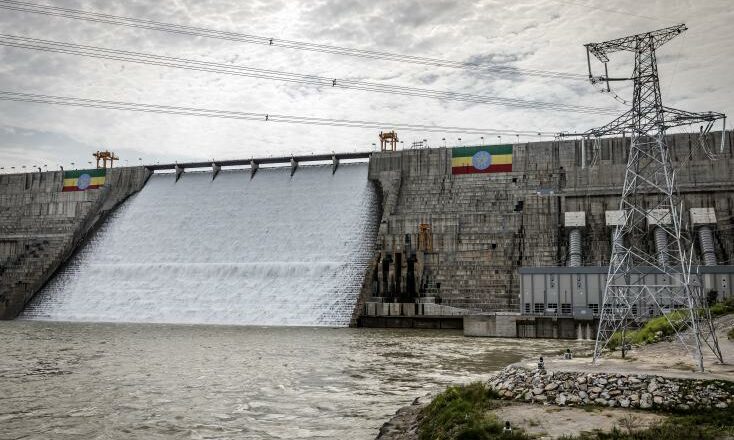
Ethiopia on Tuesday inaugurated the Grand Ethiopian Renaissance Dam (GERD), now officially the largest hydroelectric infrastructure on the African continent. A powerful national symbol, it was hailed by Prime Minister Abiy Ahmed as “a great achievement for all Black people,” despite the ongoing tensions it continues to provoke downstream along the Nile.
With a storage capacity of 74 billion cubic meters and measuring 1.8 kilometers in length and 145 meters in height, the GERD is expected to eventually generate 5,000 megawatts of electricity. This would effectively double Ethiopia’s current power output, in a country where nearly 45 percent of the 130 million citizens still lack access to electricity. The $4 billion project could yield up to $1 billion annually in electricity exports.
Launched in 2011, the dam has weathered Ethiopia’s political upheavals and, in many ways, stands as a rare symbol of national unity in a country plagued by internal conflicts, particularly in the Amhara, Oromia, and more recently, Tigray regions.
While Ethiopia celebrates, Egypt remains deeply concerned. Cairo, which relies on the Nile for 97 percent of its water needs, has long described the dam as an “existential threat.” President Abdel Fattah al-Sisi recently reaffirmed that Egypt would pursue all legal avenues to protect its water rights. Sudan shares similar fears. Both countries oppose any unilateral action on the Blue Nile Basin.
Despite over a decade of negotiations mediated by various international actors, no binding agreement has been reached. Prime Minister Abiy Ahmed sought to ease concerns during the inauguration, stating: “This will not affect your development.”
The GERD, caught between national pride and regional diplomacy, marks a historic turning point for the Horn of Africa.