
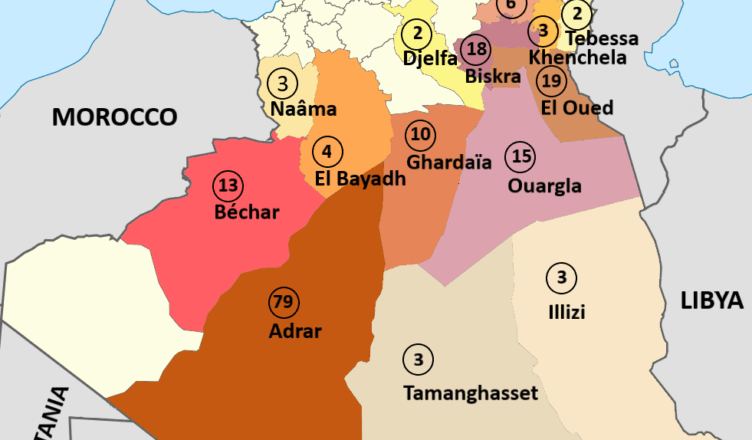
In recent discussions between Field Marshal Khalifa Haftar and his advisers, the name Illizi has resurfaced as a region historically linked to Libyan territory, according to Libyan sources.
Located in southeastern Algeria, this wilaya bordering Libya is drawing renewed interest due to tribal memory, natural resources, and regional rivalries.
Historically, the Illizi region was part of the Libyan space, covering a vast area from Ghat in Libya to Djanet, long before French colonization.
The current border, defined by colonial-era Franco-Italian agreements, notably the 1919 Treaty between France and Italy, arbitrarily separated these territories. The colonial pact ignored local cultural, social, and linguistic realities, creating an artificial boundary that has since been denounced by several anthropologists.
In 1934, Italy completed its conquest of Fezzan and attempted to integrate Ghat and its surrounding region into a project for a “Greater Libya.” However, France, which controlled Algeria, secured its hold over Djanet and Illizi. This territorial division was reaffirmed after World War II through border agreements between the colonial powers.
Since the fall of the Gaddafi regime in 2011, the Algerian army has significantly strengthened its presence in the Illizi region, fearing jihadist infiltration from southern Libya.
The gas fields exploited in the region, particularly around In Amenas, have also reinforced Algeria’s strategic interest in this territory.
Sources close to Marshal Haftar claim that some Libyan officers refer to Illizi as “a territory annexed to Algeria by France.” Such discourse is especially prevalent within the Social Council of Libyan Tribes of Fezzan, which advocates for a redefinition of borders based on pre-colonial tribal realities.
The case of Illizi highlights the complexity of Saharan borders inherited from colonialism. While the region is currently part of Algeria, its cross-border tribal roots and energy wealth make it both a historical and strategic issue.
In recent months, military movements have been observed in the border region between Algeria and Libya.