The recent graduation ceremony of a new class of Polisario Front militias at the Martyr Ammi School, reported by the Algerian news agency Sahara Press Service (SPS), comes amid a particularly tense climate.
Officially presented as a simple ceremony, the event in reality carries a much broader political and strategic significance, in light of reported military developments in the Guelta sector and the growing international rivalries now surrounding the conflict.
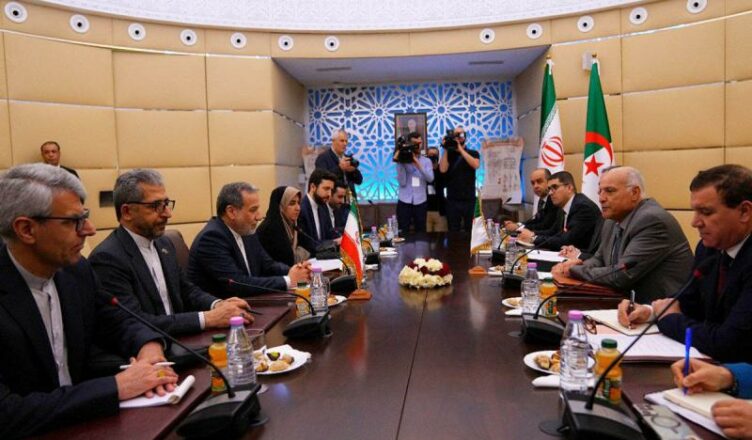
According to information gathered by Israeli intelligence services, this class was supervised by Algerian officers as well as instructors affiliated with Iran’s Islamic Revolutionary Guard Corps (IRGC), specialists in asymmetric warfare and indirect power projection through militias, combining hybrid warfare, peripheral pressure, and strategies of gradual destabilization.
The Algerian military regime, which has hosted and politically, financially, and militarily supported the Polisario from the Tindouf camps, now appears as the central pivot of a broader network.
In a context where the United States and Israel maintain an open line of confrontation with Tehran and its regional proxies, notably Lebanese Hezbollah, the Houthis, and Hamas, any operational convergence between Algiers, the Polisario, and Iranian networks would constitute a direct challenge to American interests.
On February 26, 2026, the Polisario claimed that its units had carried out several bombardments against Moroccan army positions in the Guelta area, particularly in Acharkan and behind Achark Sedra. “Heavy losses” were reported, though no independent confirmation is available at this stage.
At a time when the structural rivalry between the USA, Israel, and Iran is reshaping regional fault lines, every move by the Polisario and its backers is analyzed through a greatly expanded geopolitical lens. Regional and global rivalries tend to magnify the Saharan issue, and Algeria could thus find itself at the heart of a dynamic whose implications would extend far beyond the Western Sahara dossier alone.
Since December 2020, Washington has officially recognized Morocco’s sovereignty over Western Sahara, a decision reinforced by the strategic rapprochement between Rabat and Tel Aviv.
Washington and Tel Aviv have for several years maintained a firm stance toward Tehran, particularly because of its nuclear program, its regional influence, and its support for various armed groups in the Middle East and Africa.
Israel considers Iran an existential threat due to its nuclear program, its proxies, and its networks across the Middle East and Africa.
According to Western analysts, Western Sahara is no longer merely a diplomatic issue stalled at the United Nations. The coming months will be decisive in determining whether the region moves toward cautious stabilization or enters a new phase of high-intensity tensions. The stakes will now extend well beyond the direct standoff between Rabat and the Polisario.