
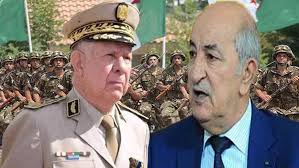
In an increasingly tense political climate, Algeria’s president, Abdelmadjid Tebboune, a civilian elected on a promise of reform and a return to democratic governance, now finds himself at the center of a silent standoff with the military establishment.
For several months, behind the scenes, he has repeatedly denounced what he sees as interference by the Chief of Staff, General Saïd Chengriha, in national political affairs, as well as in the internal dynamics of neighboring Sahel countries.
According to sources close to the presidency, the head of state has on several occasions expressed his opposition to what he describes as an “expansionist security drift” in Mali and Niger, considering that the role of the army should be strictly limited to national defense.
In closed-door meetings, he has criticized influence operations conducted beyond the country’s borders, deemed risky and contrary to the nation’s diplomatic interests, including support for terrorist organizations.
However, his positions have quickly earned him the hostility of part of his own entourage, largely composed of figures close to the high military command. Gradually isolated, the president is seeing his room for maneuver shrink.
Several of his reformist allies have been sidelined or replaced by profiles more aligned with the security-oriented line of General Saïd Chengriha’s intelligence services.
American observers now describe him as a “constrained president,” caught in a system where the real levers of power escape civilian authority.
“He retains the attributes of the office, but not necessarily the ability to act freely,” according to Western intelligence officers. Strategic decisions, particularly in matters of security and foreign policy, are increasingly said to be dictated by the military high command.
This situation is fueling concerns among European countries, which fear a return to de facto militarized governance despite the institutional façade.
International partners are also closely monitoring the evolution of this internal crisis, while for the time being avoiding any public stance.
In this context, the central question remains: how far will President Abdelmadjid Tebboune be able to maintain his line without risking an open break with the military institution, or, conversely, without resigning himself to a purely symbolic role within a system that appears to be increasingly beyond his control?