
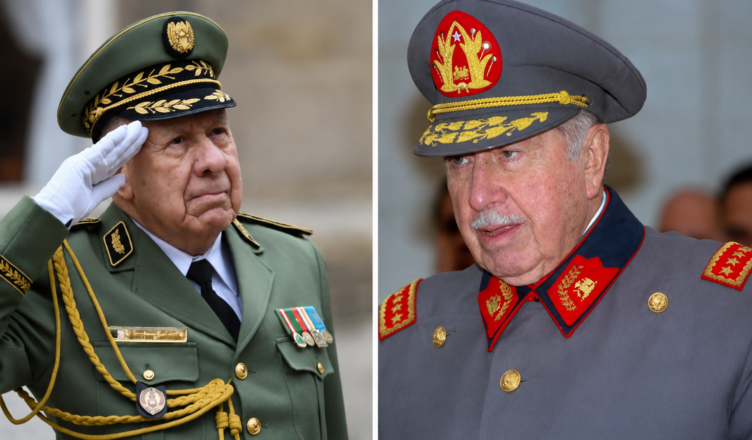
History never repeats itself in exactly the same way. But at times, its echoes can be unsettling.
In 1973, General Augusto Pinochet’s tanks brought an end to Salvador Allende’s democratic experiment. In the name of stability, national security, and the salvation of the nation, military rule replaced popular sovereignty. Civilian institutions became instruments for legitimizing a system in which the true holder of power wore a military uniform.
Today, some Western analysts argue that Algeria presents a reality which, while different in form, resembles the logic of General Pinochet’s dictatorship.
Under Algeria’s Constitution, President Abdelmadjid Tebboune is the Head of State. Yet these analysts contend that the real balance of power lies elsewhere, within the military establishment led by General Saïd Chengriha. From this perspective, the country’s major political decisions are determined not by the popular will but by the internal dynamics of the military leadership.
The methods have changed. Tanks are no longer deployed in the streets. Elections are held. State institutions continue to function. Yet one question remains: what purpose do Algeria’s legislative elections serve if the country’s most important decisions lie beyond the reach of democratic debate?
As in Chile under military rule, official discourse emphasizes stability, security, and national unity. These objectives may, at times, be legitimate. However, when they become the permanent justification for restricting civil liberties, prosecuting political opponents, or exerting pressure on the media and civil society, they fuel concerns that reason of state has come to prevail over political pluralism within an authoritarian system.
It would be inaccurate to claim that present-day Algeria is the same as Pinochet’s Chile. The historical context, institutional framework, and the scale of documented human rights violations under the Chilean dictatorship are different. The comparison is therefore not one of equivalence but of inquiry: can a democracy be fully sovereign when the military is perceived as the ultimate arbiter and guarantor of political life in Algeria?
The fundamental lesson of Chile, which has since become a democratic republic with a strong presidential system, is not merely that of a military coup. It is the warning that emerges when civilian institutions lose their autonomy in the face of military power. A nation cannot be built sustainably through the supremacy of armed force, but through citizens’ trust, respect for fundamental freedoms, and the genuine possibility of political alternation through democratic elections.
According to many critics of the Algerian authorities, contemporary Algeria displays similarities with the Pinochet era in the way its political, economic, social, and diplomatic systems operate.
From this perspective, President Abdelmadjid Tebboune appears less as an autonomous holder of power than as the civilian face of a system in which the most important decisions ultimately remain under the authority of General Saïd Chengriha’s military establishment.