
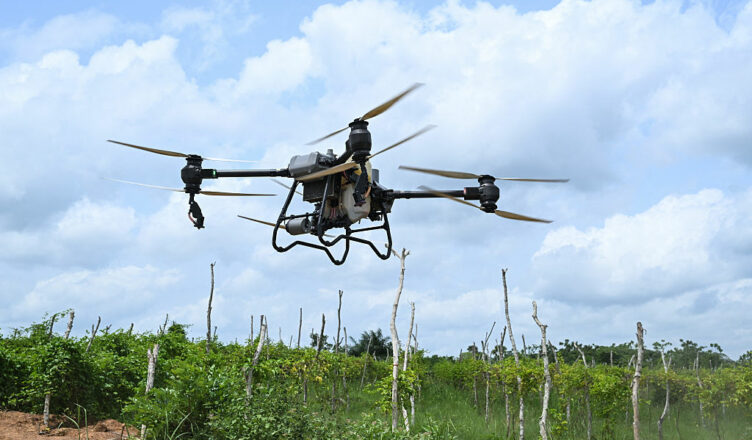
In Abuja, on the sidelines of the African Chiefs of Defence Staff Summit, several Nigerian companies showcased low-cost drones designed for military use. Inspired by commercial models, these drones are tailored to the budgetary and operational realities of African armed forces.
Since the war in Ukraine, drones, particularly modified commercial models used in “kamikaze” missions, have proven highly effective. This technological shift is now driving local innovation across the continent.
Nigerian company Epsilon, for instance, offers single-use drones starting at €830 (excluding explosives), small enough to be carried in a backpack. It’s a “fast and agile” solution, according to company engineer Oluwagbenga Karimu. Nigerian forces praise the portability and simplicity of these devices, which are often assembled locally from imported parts.
“It’s economically more rational to lose a small drone than to risk a costly aircraft,” says Muhammad Umar, technical director at EIB Group, a drone manufacturer supplying the Nigerian military. These compact drones now complement heavier, imported systems like the Turkish Bayraktar TB2.
This local innovation also responds to an urgent security reality. In northern Nigeria, the military faces jihadist groups that use homemade drones to drop explosives or grenades. Nigerian authorities are now investing in more accessible jamming and surveillance systems to counter these threats.
Opening the summit, Nigerian Vice President Kashim Shettima urged massive investment in military research, AI, cybersecurity, and domestic production of defense equipment.
According to Shettima, Africa cannot remain merely a consumer of technology. The continent must become an innovator and owner of its defense tools through a collective strategy built on regional cooperation and intelligence sharing, vital to addressing transnational threats such as terrorism, piracy, and cybercrime.