
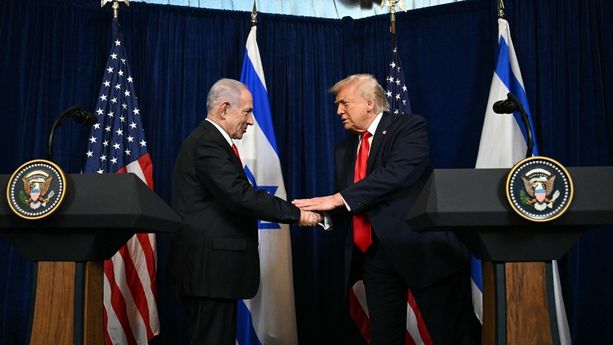
The recent visit of Israeli Prime Minister Benjamin Netanyahu to Washington placed the Iranian issue at the heart of bilateral discussions, focusing on containing—or even decapitating—the Iranian clerical regime and preventing any major shift in the regional and international strategic balance.
According to sources, one of the main topics addressed during the visit was Iran’s nuclear program, as well as the role of Tehran-backed terrorist groups.
From Hezbollah in Lebanon to pro-Iranian militias in Syria and Iraq, and from the Houthis in Yemen to the Polisario in Algeria, these actors serve as a major strategic lever for Iran, possessing substantial missile and drone arsenals.
Amid escalating regional tensions, the Iranian dossier has become Israel’s top security priority and a central point of coordination with U.S. President Donald Trump.
During discussions with the U.S. administration and members of Congress, the Israeli leader stressed what he called an “existential threat.” Key concerns include the progress of Iran’s nuclear program, the development of long-range ballistic missiles, and continued support for armed groups hostile to Israel.
Washington and Tel Aviv share a similar assessment: Iran is not merely defending its national interests but is seeking to reshape the regional balance in its favor through an expansionist strategy. This convergence has strengthened military cooperation, intelligence sharing, and diplomatic coordination.
The nuclear issue remains the most sensitive point. Israel believes that Iran has dangerously approached the technological threshold required to produce a nuclear weapon. During his visit, the Israeli Prime Minister advocated for a firm stance, asserting that diplomacy cannot be credible without the real threat of consequences.
The confrontation between Israel and Iran goes beyond a bilateral framework. It influences balances in Lebanon, Syria, the Gulf, the Red Sea, and North Africa.
Several Western, Arab, and African countries are watching the expansion of Iranian influence with concern, even as some simultaneously seek to maintain open diplomatic channels with Tehran.