
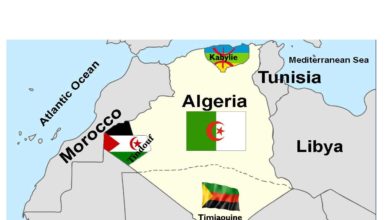
Since Algeria’s independence in 1962, political power has been built around two pillars: the extreme centralization of the state and the enduring dominance of the military institution over political life. This model, born out of the war of independence, enabled the country to preserve its territorial unity for several decades despite major crises such as the civil war of the 1990s. Today, some observers argue that the strategic choices accumulated over more than sixty years may ultimately weaken Algeria’s own cohesion.
Such a projection is mainly based on three fault lines: the Kabyle issue in the north, the geopolitical singularity of Tindouf and the Polisario in the western Saharan region, and the chronic instability of the Sahel with the emergence of Azawad in the south.
1. Kabylia: A historical divide never truly resolved
Kabylia represents the deepest identity-related issue in contemporary Algeria. From independence onward, the authorities sought to impose a centralized and Arab-nationalist vision of the state. In Kabylia, this orientation has often been perceived as a form of cultural and political marginalization of Amazigh populations.
The events of the Berber Spring in 1980, followed by the Black Spring in 2001, marked significant ruptures between a large segment of Kabyle society and the central government. Although the Amazigh language was eventually granted official recognition, many believe that this recognition remains more symbolic than structural.
Over the decades, an autonomist and later independence-oriented movement developed around the MAK (Movement for the Self-Determination of Kabylia) and Ferhat Mehenni’s Provisional Government of Kabylia. While this movement remains a minority trend at the national level, it is part of a broader international dynamic in which regional identities seek greater political recognition.
From a long-term perspective, several factors could deepen this divide:
• The concentration of power in Algiers;
• The absence of genuine regionalization;
• Persistent security-driven distrust toward Kabyle movements;
• An economic crisis reducing the state’s redistributive capacity.
If Algeria were one day to enter a major political crisis comparable to those experienced by some Arab states after 2011, Kabylia could become the primary center of a structured territorial challenge.
2. Tindouf and the Polisario: A lasting geopolitical anomaly
For nearly half a century, the camps of Tindouf, located on Algerian territory, have represented a unique situation in the world: a politico-military movement, the Polisario Front, exercises a form of autonomous authority there under the protection of the Algerian regime.
This situation has long served Algeria’s geopolitical interests in its regional rivalry with Morocco over Western Sahara. However, some analysts now argue that this strategy has created a hybrid zone that may be difficult to control in the long term.
Several risks are frequently mentioned:
• The Polisario’s total dependence on Algiers;
• The prolonged militarization of the camps;
• Generational frustrations among Sahrawi populations, particularly those originating from African countries, who are said to represent more than 98% of camp residents;
• Increasing overlap between Saharan territories and criminal or jihadist networks operating in the Sahel.
Some experts even speak of the possible transformation of the area into a kind of militarized and autonomous “Saharan city-state,” sustained by its own political, security, and economic networks under the authority of Brahim Ghali or his successors.
3. Azawad and the Sahelian risk
For the first time, in southern Algeria—directly connected to Sahelian dynamics—in Bordj Badji Mokhtar, militiamen from the Azawad Liberation Front reportedly paraded publicly with flags and vehicles.
Since the collapse of Libya in 2011, the Sahel-Saharan region has become a theater for armed groups, trafficking networks, Tuareg rebellions, and jihadist organizations competing for control over vast territories. Southern Algeria is now directly connected to these Sahelian dynamics.
Azawad, claimed by Tuareg movements in northern Mali, symbolizes this regional reconfiguration. Although Algeria has long played the role of mediator in Malian crises, it now finds itself trapped in a much more unstable environment than before.
Iyad Ag Ghali, also known as Abu Fadl, described in the article as a creation of the Algerian intelligence services and leader of the Group for the Support of Islam and Muslims (GSIM/JNIM), is presented as a key architect of the alliance with Tuareg rebels of the Azawad Liberation Front (FLA) associated with Imam Mahmoud Dicko.
The danger for Algiers lies in the gradual spread of Sahelian fragmentation dynamics:
• Weakening border control;
• Expansion of informal economies;
• Movement of weapons and fighters;
• Emergence of new cross-border identities.
Southern Algeria, vast and sparsely populated, could become more closely connected to the Sahelian dynamics of Tuareg populations than to Algeria’s political center.
4. The Algerian paradox: Military power and political fragility
Algeria is still often regarded as one of Africa’s major military, political, and economic powers. However, despite its army under General Saïd Chengriha and the still-functioning state apparatus of President Abdelmadjid Tebboune, several structural weaknesses continue to affect the system:
• An economy heavily dependent on hydrocarbons;
• A frequently disillusioned youth population;
• A political system perceived as closed;
• Identity tensions that have never been fully resolved;
• Regional and international diplomacy facing an increasingly hostile environment.
The real risk for Algeria may not be a sudden collapse, but rather a gradual erosion of central authority over its peripheral regions.
5. A possible projection: Toward a federal or fragmented Algeria
In the long term, two opposing trajectories appear possible.
The first would involve profound reform:
• Genuine political opening;
• Advanced regionalization;
• Broader recognition of local identities;
• Economic integration of the south;
• Regional normalization with neighboring countries.
Under this scenario, Algeria could preserve its unity by evolving into a more flexible and pluralistic state.
The second trajectory would involve maintaining the current model without structural reforms. In that case, peripheral tensions could accumulate and eventually lead to gradual fragmentation:
• A dissident Kabylia;
• An autonomous Tindouf;
• A southern Algeria increasingly influenced by Azawad and broader Sahelian movements.
History shows, however, that no geopolitical projection is inevitable. States that appear strong can collapse rapidly, while others survive for decades despite deep internal divisions. Algeria’s future will depend largely on its ability to reinvent its internal political contract within a regional environment undergoing constant transformation.
Sources and analytical references
This analysis draws on academic research, international reports, geopolitical and security studies, as well as field-based sources concerning Algeria, Kabylia, Western Sahara, and the Sahel.