
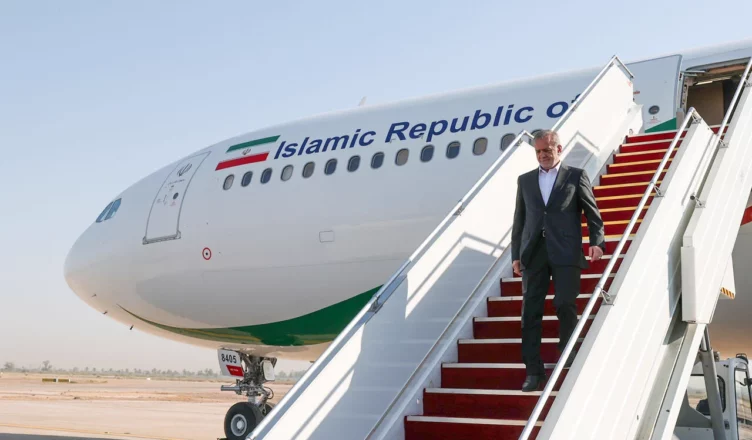
The stopover in Algiers of the Iranian aircraft, before Massoud Pezeshkian, President of the Islamic Republic of Iran, continued his journey to New York to participate in the United Nations General Assembly, is not merely a technical detail being examined by U.S. services.
For the various intelligence services, in the current context in the Middle East, Europe and North Africa, this gesture of welcome by the Algerian military regime or the government of President Abdelmadjid Tebboune takes on another significance and represents a strong signal to U.S. President Donald Trump and his administration.
While U.S. President Donald Trump is regarded by several countries as the man of peace, the only warrior and strong leader of this decade against terrorist organizations, and as the figure behind the restoration of a new world order based on justice, social affairs, the economy and artificial intelligence.
For geostrategic analysts, Iran openly assumes its support for several terrorist organizations operating in the Middle East and North Africa. The welcome extended to the Iranian president by Algiers appears to represent an alliance between Algiers and Tehran.
This confirms the presence of officers from Iran’s Islamic Revolutionary Guard Corps and other terrorist elements in secret bases or military barracks in Algeria.
Presenting this stopover as a matter of Algerian political sovereignty, as done by Algerian official media, goes beyond a technical gesture. Diplomacy is made up of symbols, choices and signals. And the one sent by Algiers to Tehran is difficult to ignore.
Iran is at the heart of an international network of terrorist forces and organizations. Through its support for Hezbollah, Hamas, the Houthis, the Polisario Front, the Azawad Liberation Front, and jihadists in the Sahel, Algeria and Iran have built a genuine strategic machine of influence and indirect confrontation with the United States.
Algiers has always expressed its hatred of Jews and the State of Israel, its support for Palestinian terrorists rather than Palestinians, as well as for the Polisario Front in Western Sahara. This position constitutes a constant element of its propaganda within Algerian society.
A question has always been raised, and with increasing urgency: where does support for the Palestinians and the Polisario Front end, and where does proximity to Iran’s regional strategy begin?
The rapprochement between Algiers and Tehran comes in an environment in which Iranian policy cannot be separated from this regional strategy.
The Algerian government regularly invokes national sovereignty to justify its diplomatic choices. The message addressed to other capitals is clear: Algiers intends to pursue its policy without allowing its choices to be dictated by Washington, President Donald Trump or his allies.
By multiplying political convergences with Iran, Algiers gives the impression of being a partner whose positions are drawing closer to those of Tehran on the main issues in the Middle East and Western Sahara.
For experts, Iranian policy in the Middle East, North Africa and the Sahel rests on a reality that cannot be ignored: Tehran uses its influence over armed organizations to extend its capacity for action far beyond its borders.