
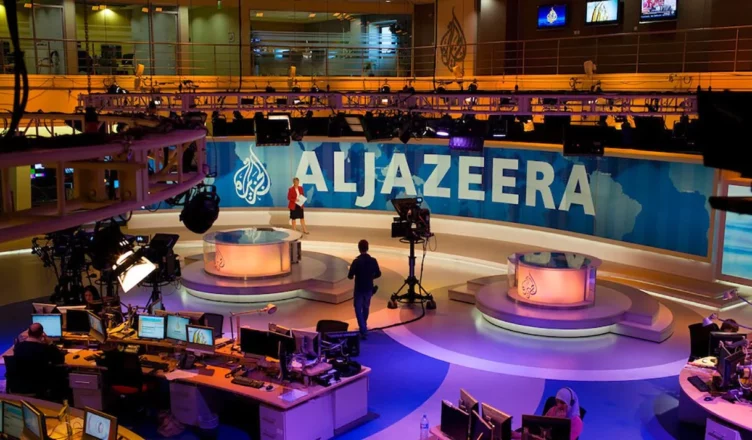
As the war in Gaza continues to rage, another equally strategic and asymmetrical battle is unfolding: the information and disinformation war waged by Al Jazeera.
The channel provides continuous coverage of solidarity demonstrations, accusations of war crimes in Gaza, issues surrounding the delivery of military equipment to Israel via alleged Mediterranean ports, and most notably, the tensions regarding the normalization of relations with several Arab and African countries.
In this invisible battlefield, the Qatari network Al Jazeera holds a central position. Today, it represents one of the most influential faces of the media war against Israel, as well as against Arab and African nations, in a context where communication becomes as powerful a weapon as conventional arms.
Widely followed across the globe, Al Jazeera asserts itself as a committed and firmly pro-Palestinian player.
Its strategy is clear: to mobilize public opinion against Israel and its allies, to put pressure on governments that have signed the Abraham Accords, and to amplify public anger through emotional and immersive coverage.
Behind this media offensive, Qatar plays a key role, having long supported Hamas politically, financially, and through media platforms.
Al Jazeera is merely the most visible front of a much broader influence operation, which also includes the funding of NGOs or associations ideologically aligned with Hamas or the Muslim Brotherhood.
However, Qatar does not engage in this media war without calculation. It remains a strategic ally of the United States, maintains channels of dialogue with Israel, and hosts the largest U.S. military base in the region.
In other words, Qatar is not seeking a regional rupture, but rather aims to preserve its image as a defender of the Palestinian cause and to maintain its influence over the Arab street. As international observers recall, Al Jazeera was a key provocateur of the Arab Spring, standing in contrast to its rivals, the United Arab Emirates and Saudi Arabia.