
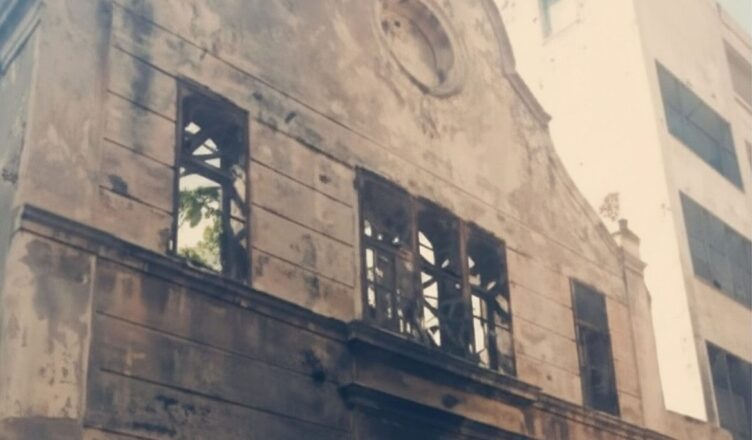
Under the pretext of public safety, Algerian authorities have demolished the historic Chaloum Lebhar synagogue, located in the working-class neighborhood of Bab El-Oued in Algiers. Built in 1894, the synagogue was for decades a central place of worship and community life for the city’s Jewish population. Officially justified by a supposed risk of collapse, the demolition is seen as yet another erasure of Algeria’s pluralistic past.
According to multiple sources, descendants of Algerian Jews, quietly supported by a foreign embassy, had attempted to save the building by seeking its classification as a historical heritage site. However, their efforts were either ignored or blocked by Algeria’s bureaucracy, delaying but not preventing the inevitable: the disappearance of one of the last physical traces of a once-thriving Jewish presence.
Before Algeria’s independence in 1962, the country was home to nearly 130,000 Jews. Today, only a handful remain, living in near-total social and religious invisibility. Chaloum Lebhar was more than just a religious monument, it was a piece of collective memory, a testament to centuries of Jewish-Muslim coexistence that postcolonial Algeria seems intent on erasing, from both its city walls and its history books.
The official reasoning of structural danger rings hollow in a country where numerous crumbling buildings, some arguably far more hazardous, still stand in city centers. The real difference here lies in the nature of the building: a synagogue, a relic of a past the government would rather forget than restore.
This demolition reflects a broader trend: the gradual erasure of Jewish heritage in Algeria. Synagogues, abandoned cemeteries, homes, and archives are disappearing from public records and physical landscapes. It’s a cultural, spiritual, and architectural memory being wiped away amid official silence and widespread indifference.
Tearing down the Chaloum Lebhar synagogue is not just the destruction of a building, it’s the burial of a chapter of Algerian history. It sends a message that only one narrative fits the national memory: an Algeria cleansed of its diverse past. When history becomes inconvenient, it is bulldozed.