
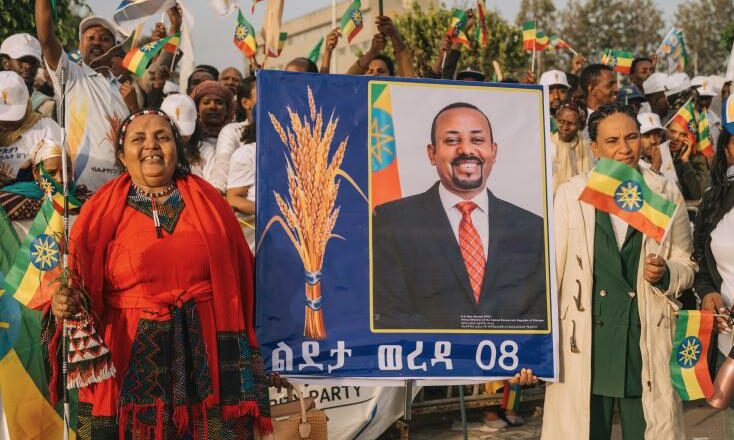
The Prosperity Party (PP) of Ethiopian Prime Minister Abiy Ahmed won a landslide victory in the June 1 legislative elections, securing more than 90% of the seats allocated in the House of Peoples’ Representatives, according to official results announced by the National Election Board of Ethiopia (NEBE).
Of the 486 seats ultimately filled, the Prosperity Party won 438, further consolidating its dominance over Ethiopia’s political landscape. The new parliament, which comprises 547 seats, will be tasked with electing the next prime minister when the parliamentary session opens between late September and early October. Barring any surprises, Abiy Ahmed is expected to seek another term as head of government.
The vote, however, took place in a context marked by significant security tensions. Elections had to be postponed in 15 constituencies across three regional states, including Oromia, the country’s most populous region. In addition, the 38 seats allocated to Tigray will remain vacant, as voting could not be held there due to the aftermath of the conflict that pitted Tigrayan forces against the federal army between 2020 and 2022 and claimed nearly 600,000 lives.
Disruptions were also reported in the Amhara region, where the nationalist Fano militias have been fighting federal forces for more than three years. According to the conflict-monitoring NGO ACLED, at least 90 clashes were recorded in the region on election day. In Oromia, attacks attributed to the Oromo Liberation Army (OLA) also resulted in several civilian casualties and hampered the conduct of the electoral process.
The Electoral Commission stated that 143 polling stations did not open due to security concerns, while voting was suspended in several other polling centers.
The election was also held in the absence of a strong and united opposition. Around forty parties contested the polls, but the main opposition party, Ezema, fielded only 293 candidates, compared with 461 for the Prosperity Party, which ran unopposed in 64 constituencies.
Since coming to power in 2018, Abiy Ahmed has been praised for his political reforms and democratic opening. However, he now faces growing criticism over the repression of dissenting voices and restrictions on the media.
Despite ongoing conflicts and social challenges, Ethiopia’s economy is projected to maintain strong growth prospects. According to the International Monetary Fund, the country could record economic growth of more than 9% in 2026, one of the highest rates in the world. Nevertheless, poverty remains a major concern, affecting approximately 43% of the population, according to the World Bank.