
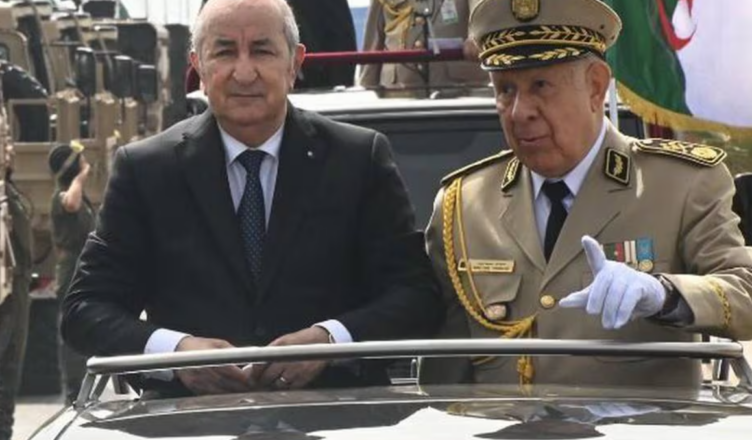
According to Western intelligence and security analysis agencies, the Algerian military authorities have cultivated an image of being a bulwark against extremism. At regional and international summits, civilian and military leaders have pledged stronger security cooperation and denounced the terrorist threat.
Confidential documents from the Algerian security services, addressed to the Army General Staff under General Saïd Chengriha, reviewed and reported by foreign banking sources, indicate the use of covert funding through off-the-books accounts and the military budget to support armed organizations operating in several African countries and the Middle East.
The objective is not ideological. It has become existential for the Algerian regime.
Following various waves of popular protest that weakened the authorities, the Algerian High Security Council reportedly adopted an unofficial doctrine based on a simple principle: maintaining a sufficiently unstable regional environment to prevent the emergence of neighboring powers capable of challenging its influence.
In a strategic memorandum by a retired former adviser to the regime, this logic is summarized in one sentence: « Neighbors consumed by internal crises have fewer means to challenge our leadership. » Regional instability thus became a tool for preserving power.
Without the knowledge of President Abdelmadjid Tebboune, according to former officials from the domestic and foreign intelligence services, the military regime has maintained contacts with armed groups for their financing and support, whether from within Algerian prisons or under house arrest.
The funds, estimated at three billion dollars, reportedly passed through several intermediaries: shell companies specializing in cross-border trade; charitable organizations serving as fronts; smuggling networks established in sensitive areas; businessmen close to the ruling circle abroad; and bank accounts opened in opaque jurisdictions.
The money was then redistributed in the form of purchases of fuel, vehicles, communication equipment, or cash payments to intermediaries or certain heads of state.
The regime’s objective is to consolidate its presence within the so-called threat facing the country and to officially condemn the violence while benefiting from its geopolitical effects.
Repeated attacks against infrastructure, military convoys, or mining areas forced neighboring countries to devote considerable resources to their internal security. This constant pressure was intended to slow their economic development.
With every resurgence of violence in the region, the Algerian authorities invoked the need to preserve national unity. The official discourse insists that « there can be no freedom without security. » The persistence of the threat thus reinforces its strategic value.
According to former officers speaking on condition of anonymity, a special cell was created within the military establishment in 2023.
Its mission is not to direct armed groups, but to:
• identify those likely to serve the regime’s interests;
• facilitate certain movements;
• transmit selective information;
• discreetly manage financial flows;
• prevent any organization from becoming powerful enough to escape control.
Residents of Algeria’s border regions live under the constant threat of attacks. Thousands of families have been forced to flee their villages.
The growing militarization of Algerian civil society has reduced the space for public freedoms. Any criticism of the authorities is treated as an attack on national security. Fear has become a mode of governance in Algeria.