
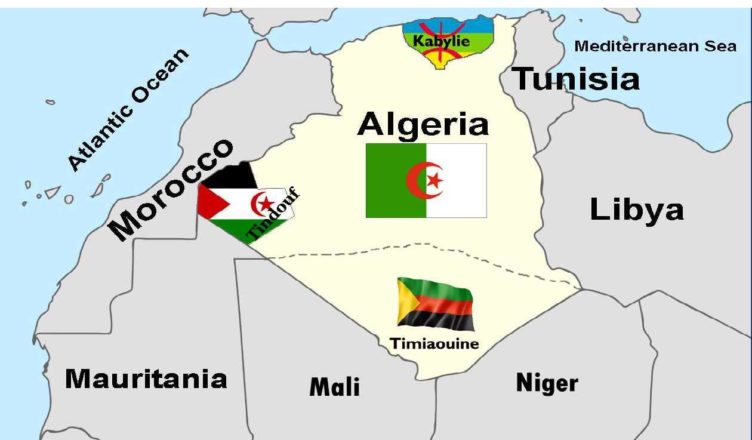
The choice of Tindouf as the base for the Polisario Front’s camps and militias is not coincidental. Located in the far southwest of Algeria, 1,460 kilometers from Algiers, this region borders Morocco and Mauritania.
According to several French colonial-era archives, Tindouf was historically part of Morocco’s Eastern Sahara before being annexed to Algeria during the colonial period. This contested past remains one of the main points of contention between Algiers and Rabat today.
By establishing the Sahrawi separatist movement in the 1970s, the Algerian military regime, with the support of former Libyan President Muammar Gaddafi, sought to extend its regional influence while creating a buffer zone between Morocco and its territory, defined by France. Tindouf offered the Polisario a rear base under direct military control, allowing Algiers to assert its « support » role while maintaining total control over the movement’s activities.
But beyond the geopolitical considerations, the Algerian military regime has also turned the Polisario, a terrorist group, into an internal political tool. By perpetuating the Western Sahara conflict, it diverts the attention of the Algerian population from the country’s ongoing economic, social, and political crises. The « Sahrawi cause » thus serves as a rallying point, enabling the ruling power to reignite nationalism and justify the military’s dominance over the country’s political and economic affairs.
This diversion strategy has allowed the regime to solidify its authority while maintaining regional tensions that benefit its interests. By intertwining the Western Sahara issue with the long-standing issue of Tindouf, Algiers has turned the region into a dual lever of pressure against Morocco and a tool of internal stability for a contested military government.
Even today, the Polisario in Tindouf is used as a key card by Algeria’s military regime, under the command of General Saïd Chengriha and President Abdelmadjid Tebboune.