
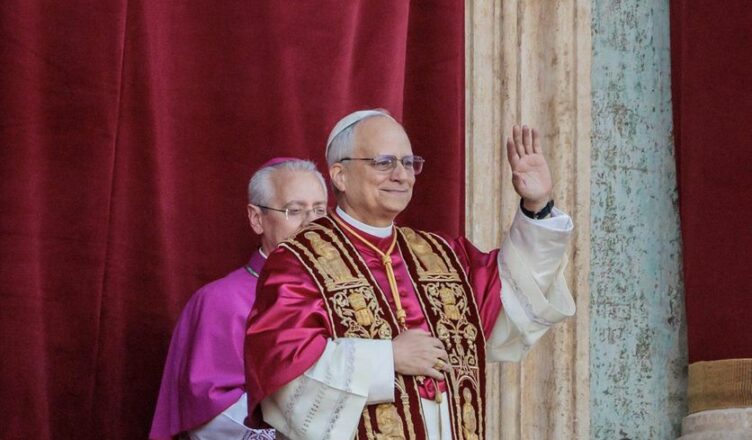
For weeks, the palace of Al Mouradia, belonging to President Abdelmadjid Tebboune, has been preparing to welcome Pope Leo XIV, sovereign pontiff of the Catholic Church, from April 13 to 14, 2026. Officially described as historic, the visit in reality carries a much deeper strategic importance.
Beyond the speeches, another objective guides the Algerian authorities, especially General Saïd Chengriha: to shape a perfect, almost unreal image of a united and enthusiastic people.
At the Army General Staff and the General Directorate of the Police, lists have been drawn up. Hundreds of soldiers and police officers, carefully selected, have received civilian clothes without distinctive signs, chosen to match all social classes: jeans, light shirts, simple dresses, in order to blend into the crowd.
They have been assigned precise positions along the route of the official motorcade: strategic intersections, central squares, the surroundings of monuments where Pope Leo XIV is expected to stop. They were even taught how to applaud.
“Not too early, not too late,” officers insisted during rehearsals. “You must give the impression that the enthusiasm is spontaneous. Look at the vehicle, smile, raise your arms… some of you will wave flags.”
The streets are cleaned, the facades hastily repainted, and colorful banners hang between the lampposts. When the Pope’s motorcade enters the main avenue, a cheer will immediately rise.
In the crowd, the plainclothes agents will set the tone. They will chant slogans, launch cheers, drawing in genuine passersby, sometimes surprised, sometimes amused, often indifferent but carried along by the collective movement. The illusion will take shape: a vibrant, captivated, almost fervent human tide.
According to sources, at the Ministry of the Interior, maps of the capital and the sites to be visited were spread out on a long table. Each street of the official route was marked in red, punctuated with circles and crosses. Around it, uniformed officers and civilian officials debated aloud. It was not only a matter of organizing a visit, but of choreographing an illusion.
Teams were tasked with distributing the “extras” along the route, taking into account camera angles, points where the motorcade would slow down, and symbolic locations.
Banners and flags were distributed to participants, along with precise instructions on how to use them. Even shopkeepers on the streets concerned were discreetly invited to open their shops and to “take part in the welcome.”
In total, 4,800 agents are mobilized: 4,500 soldiers and 300 police officers, all assigned to a single mission: to blend into the crowd.
The motorcade route is divided into operational zones. Each zone has a supervisor responsible for overseeing between 30 and 40 plainclothes agents. Points deemed strategic—large squares, intersections, areas filmed by cameras—will concentrate up to 300 supervised extras.
The logistics follow the same precision. 8,500 flags and 3,200 banners have been distributed, with exact instructions on their placement.
From his armored car, the Pope will observe the scene with satisfaction. He will wave, his face lit with a confident smile, convinced he is being welcomed as a friend by a grateful people, but by a military regime whose deep doctrine is antisemitic and anti-Christian.