
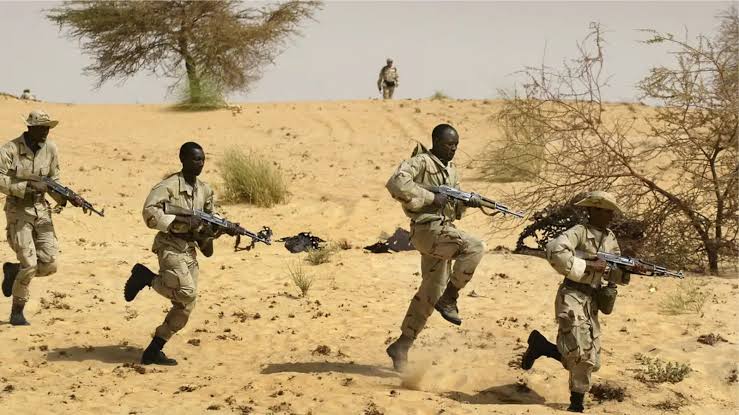
While Algeria and Mali announced on Friday the reciprocal reopening of their airspace and the return of their ambassadors after fifteen months of diplomatic tensions, fighting has continued in northern Mali, where around thirty Malian soldiers were killed in fierce clashes around the town of Anéfis.
The latest fighting comes amid a tense regional climate. Relations between Bamako and Algiers have deteriorated sharply in recent years, with the Malian authorities accusing Algeria of interference and of supporting Tuareg armed groups as well as jihadist organizations affiliated with Al-Qaeda and the Islamic State. Mali enjoys the backing of Burkina Faso and Niger within the Alliance of Sahel States (AES).
Malian Army Chief General Jean Elysée Dao said the fighting also left around sixty soldiers wounded, several of them seriously. The battle, which lasted several days, pitted government forces against fighters from the Azawad Liberation Front (FLA), a predominantly Tuareg separatist movement.
In a statement issued on Saturday, the FLA claimed it had inflicted on the Malian army and Russian paramilitary forces from the Africa Corps « the heaviest human and material losses in their history in the region. » The movement nevertheless acknowledged that it had also lost several of its fighters.
The clashes erupted after a coordinated offensive launched on July 4 by the FLA and the Jama’at Nusrat al-Islam wal-Muslimin (JNIM), an Al-Qaeda affiliate, which claimed to have captured Anéfis. Despite that advance, Malian troops and Africa Corps personnel entrenched in a military camp held their positions until reinforcements arrived on Thursday evening.
Supported by air assets, a large military convoy that departed from Gao succeeded in reaching Anéfis despite several ambushes. The Malian army said it had secured the road corridor and regained control of the town, announcing that it had neutralized nearly one hundred fighters. FLA spokesman Mohamed Elmaouloud Ramadane confirmed that his forces had withdrawn, describing the move as a strategic decision intended to avoid civilian casualties.