
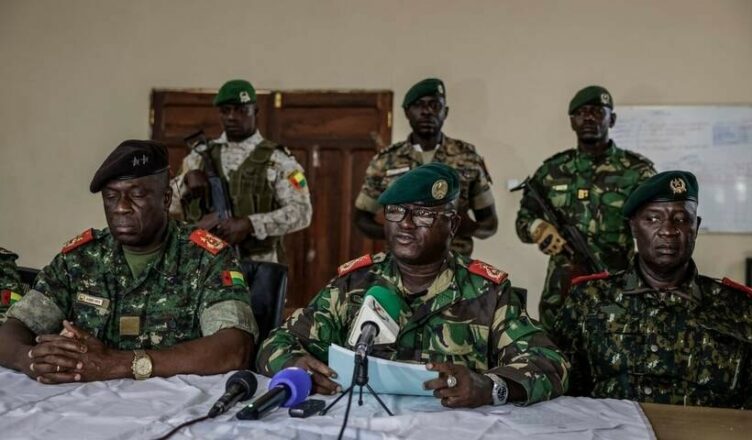
On Wednesday, a group of soldiers in Guinea-Bissau announced they had taken « full control » of the country, detaining outgoing President Umaro Sissoco Embalo and suspending the ongoing electoral process. This announcement came as the country was awaiting the results of the presidential and legislative elections held the previous Sunday.
Guinea-Bissau, a small West African country located between Senegal and Guinea (Conakry), is accustomed to political crises. Since gaining independence in 1974, it has experienced multiple coups and several attempted uprisings.
The events unfolded quickly in the early afternoon. Gunfire was heard near the presidential palace in Bissau, the capital, as soldiers took positions on the main avenue leading to the seat of power. In response, hundreds of civilians fled the area, some on foot, others by car, trying to escape the gunfire that lasted for several hours.
Soon after, a statement was issued by General Denis N’Canha, head of the military household of the presidency. Accompanied by armed soldiers, he announced that the military, in the form of a « High Command for the Restoration of Order, » had assumed control of the country « until further notice. » President Embalo, who was widely seen as the favorite in the presidential election, was placed in detention « at the general staff headquarters, » according to a member of the military, who assured that he was « well treated. »
The military explained its actions by citing a « threat to national security, » related to intelligence services uncovering a plot aimed at destabilizing the country. According to General N’Canha, this plan involved influential figures in the drug trade, a persistent issue in the region.
The consequences of this coup are being felt internationally. Over 6,780 soldiers from the ECOWAS Stabilization Force were deployed in Guinea-Bissau to ensure security during the election period. The international community has reacted strongly. The African Union, ECOWAS, and the West African Elders Forum issued a joint statement expressing their « deep concern. » These organizations condemned what appears to be a « blatant attempt to disrupt the democratic process » and called for the rapid restoration of constitutional order.
This coup marks another chapter in Guinea-Bissau’s political turbulence, a country where stability remains fragile and hopes for a democratic transition are once again called into question.