
Three months after the opening of the trial of five men accused of carrying out the deadly 2022 church attack, many uncertainties remain regarding their affiliation with a jihadist group, complicating the proceedings.
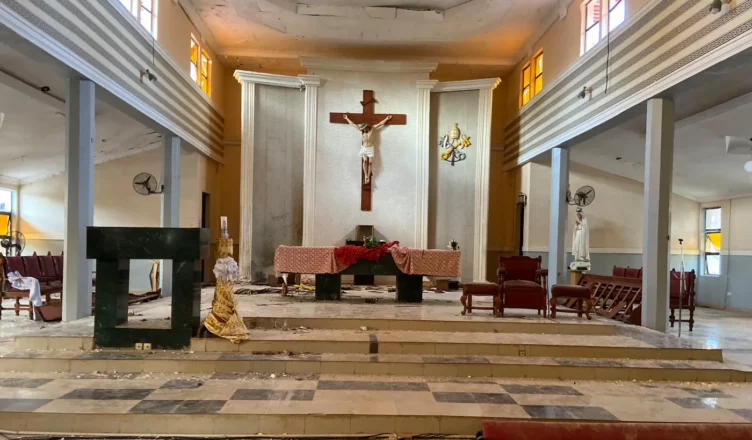
On June 5, 2022, attackers stormed a Catholic church in Owo, in southwestern Nigeria, opening fire during Sunday Mass. The attack, which left more than 40 people dead, deeply shocked a country unaccustomed to this type of religious violence in the region.
At the heart of the trial lies a major question: to which organization are the accused actually linked? The charges refer to a group named “Al-Shabaab” operating in Kogi State. However, this designation is confusing, as it may refer either to the Somali jihadist movement affiliated with Al-Qaeda or to a generic Arabic term meaning “the youth.”
For a long time, it was difficult to clarify this point. Arrested in August 2022, the suspects were held for nearly three years in a secret location without access to a lawyer, according to their defense. Before the trial began, several local media outlets presented them as linked to the Somali group.
However, since hearings opened in December, another hypothesis has emerged. The accused are said to be affiliated with a local cell called “Al-Shabab,” with no connection to Somalia. This structure is believed to be linked to ISWAP, the West African branch of the Islamic State group, active in northeastern Nigeria.
This version was supported by a security officer during a hearing in February. It also aligns with early suspicions expressed by Nigerian officials shortly after the attack, who had already pointed to ISWAP.
This ambiguity has fueled criticism regarding the quality of the investigations. Experts have raised questions about the reliability of the intelligence and evidence gathered by the authorities. In addition, four of the five accused claim to have been subjected to abuse and torture in detention, allegations echoed by their lawyer.
Human rights organizations regularly denounce such practices, as well as the use of anti-terrorism laws that allow prolonged detention without access to legal defense.
In the absence of a clear claim of responsibility, this case illustrates the complexity of armed networks in Nigeria, where alliances and rivalries between groups make accountability difficult to establish.
The trial, being held in Abuja, is also slowed by technical constraints, such as translation issues and power outages. The defense’s closing arguments are expected soon, although no date for a verdict has yet been set.