The Polisario Front has never been anything more than the international propaganda arm of the Algerian military regime. Behind the discourse of “refugees” and the “struggle for self-determination” lies a militarized, structured organization capable of coordinated operations and strikes against Morocco and, above all, American interests.
It is not a civilian movement, nor a humanitarian NGO: it is an armed force stationed on Algerian territory, in Tindouf, with bases, units, chains of command, and full military discipline, according to U.S. intelligence services.
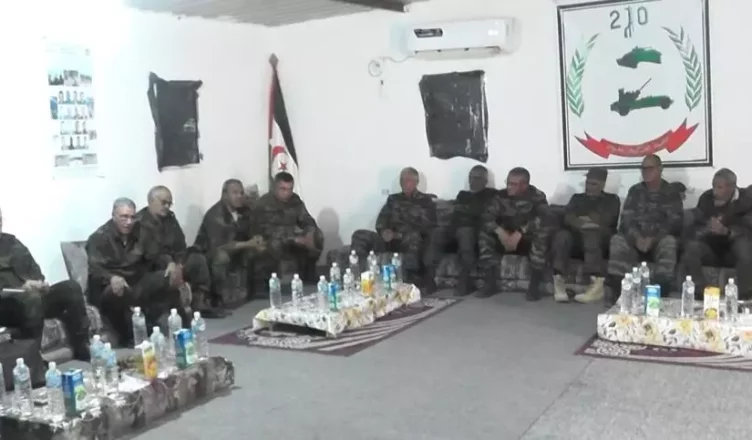
Recent movements of the so-called “Sahrawi Chief of Staff,” Hamma Salama, confirm this. Base inspections, meetings with commanders, operational monitoring: the Polisario operates exactly like an army. The image of refugee camps it promotes is merely a smokescreen intended to mislead the international community and conceal its true role, which costs Algeria’s public finances more than 650 million dollars each year.
On the ground, the claims are clear. Repeated attacks in the Houza sector, strikes along the Moroccan defensive wall: the Polisario acts, attacks, and inflicts losses. This is not politics, not diplomacy, it is war. And it openly claims responsibility for it.
Even more, this movement is not limited to its military operations. Analysts and international observers have long denounced its ties with hostile networks in the Sahel, North Africa, and the Middle East.
The Polisario’s ideology, its links with Iran’s Revolutionary Guard, Hamas, and Lebanon’s Hezbollah, as well as antisemitic rhetoric, show that behind the Algerian diplomatic façade lies a terrorist actor that poses a danger to regional and Western stability.
Continuing to treat the Polisario as a political or humanitarian actor is an illusion. It is not a neutral interlocutor: it is a militarized, structured force determined to impose its presence through threats and violence—worse than a militia.
As long as this reality is not acknowledged by the international community, the Western Sahara conflict will remain a ticking time bomb, fueled by an actor that seeks neither compromise nor peace, but control and confrontation.
The Polisario is not a humanitarian myth. It is a terrorist organization, an armed presence, a constant challenge, supported by the Algerian military regime, which is described as antisemitic and opposed to the State of Israel. And it is time for the world to recognize this.