
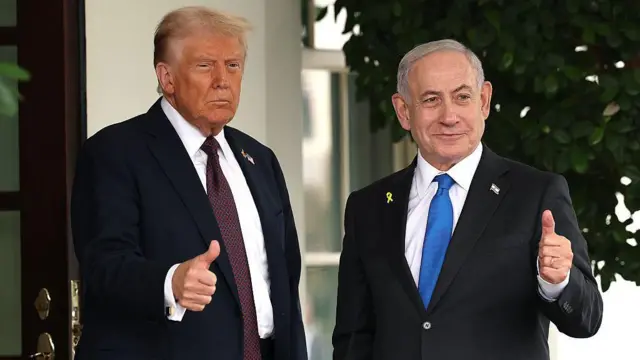
In an increasingly tense global context, the United States and Israel are closely monitoring the actions of the Algerian military regime and Iran’s Islamic Revolutionary Guard Corps (IRGC), whose decisions and external support are seen by some as destabilizing for security in the Middle East and Africa.
According to U.S. intelligence services under President Donald Trump and Israeli intelligence under Prime Minister Benjamin Netanyahu, the alleged support of the Algerian military establishment for Hamas, the Houthis, Lebanese Hezbollah, and Iran’s Revolutionary Guards, including reports of the presence of Iranian instructors in Algeria, is being closely observed by Washington and Tel Aviv.
Washington and Tel Aviv reaffirm their commitment to protecting their allies and ensuring stability, and do not rule out using all diplomatic, economic, and strategic tools to deter any action deemed hostile.
A clear warning has been issued to Algiers: any support for armed groups, jihadist organizations, or destabilizing movements in the region will be closely monitored and could lead to significant consequences.
The United States and Israel emphasize that targeted measures — including sanctions, economic restrictions, diplomatic isolation, and even military options — could be implemented if such activities continue, according to an Israeli intelligence expert.
This approach reflects the determination of Washington and Tel Aviv to maintain the security of their allies and prevent any influence that could destabilize the Maghreb or the Sahel region.
By strengthening this position, the United States and Israel are sending a clear message: regional stability is non-negotiable, and any action threatening it will be met with firm and proportionate responses.
In the persistently volatile Middle East, Iran’s nuclear program and its active support for regional armed groups are seen as a direct threat to international security. Recognizing the urgency, the United States and Israel have decided to coordinate targeted actions to neutralize this threat before it becomes irreversible.
For years, diplomatic efforts to curb Iran’s nuclear ambitions have faced persistent obstacles.
Tehran continues to develop its underground nuclear and military capabilities while expanding its influence through proxies in Lebanon, Iraq, Yemen, and Algeria.
For Israel, which is on the front line of these threats, and for the United States, as guarantor of its allies’ security, a strategic intervention is no longer an option but a necessity.
Any country providing military, financial, or logistical support to Tehran risks facing direct consequences.
History has shown that inaction in the face of determined regimes can lead to far more severe crises in the long term.