
Mali is facing a critical security situation following attacks that have left at least hundreds of civilian and military casualties, according to security sources.
Northern Mali will be the key to changing regimes in Mali, Niger, Burkina Faso, Chad, and Mauritania, according to Western experts.
From his residence in Algeria, at the heart of Sahelian influence networks, Imam Mahmoud Dicko is no longer limited to embodying a moral authority.
He presents himself as a spiritual guide endowed with superior authority, which some compare to a form of centralized religious leadership, similar to the Iranian model. In his statements, he is described by his supporters as a quasi “caliphal” figure, embodying both moral and religious leadership beyond the simple spiritual framework.
Kidal, Gao, Timbuktu—three names, three symbols, three territories of the Malian state where the Guide is now concentrating his efforts, with directives from Algerian intelligence services.
Whoever controls these territories does not only control cities: they control routes, alliances, and regional balances.
According to local sources in Tamanrasset, the situation on the ground has been marked by developments deemed concerning. A battalion of the Algerian army belonging to the 4th Military Region reportedly joined the 6th Military Region, split into five units in order to limit detection by satellite surveillance.
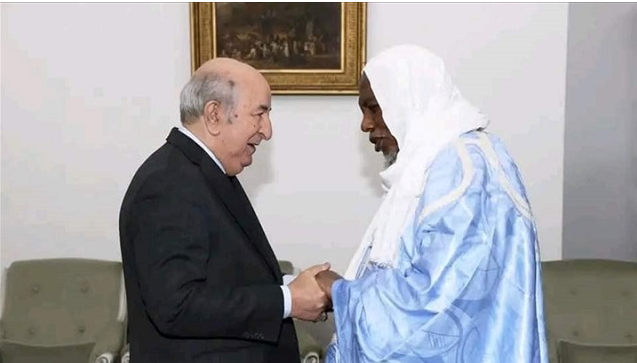
The Algerian regime, led by General Saïd Chengriha and President Abdelmadjid Tebboune, has reportedly committed to supporting the militias of Imam Mahmoud Dicko as well as armed jihadist groups in order to occupy northern Mali, and then target the heads of state of Sahel countries, taking advantage of the military operation conducted by the U.S. administration of President Donald Trump against Iran and by the State of Israel against Iranian proxies.
Officially, Mahmoud Dicko remains an exile in Algeria, like former Iranian leader Khomeini in France.
Unofficially, in the emerging reality, he is positioning himself as a center of decision-making, extending his influence where the Algerian state, led by President Abdelmadjid Tebboune and General Saïd Chengriha, is no longer able to assert itself, in order to support it for existential reasons.
“Following the latest attacks on Saturday, April 25, in several locations across the country, including Bamako, the security situation remains extremely volatile,” the French Foreign Ministry (Quai d’Orsay) stated.
France is recommending that its nationals present in Mali “plan a temporary departure as soon as possible via the commercial flights still available,” according to updated instructions published Wednesday by the Ministry of Foreign Affairs.
Meanwhile, Mali’s leader, General Assimi Goïta, stated on Tuesday that the country’s security situation was “under control,” three days after unprecedented attacks carried out by armed groups.
Goïta spoke for the first time since the deadly attacks by jihadists from JNIM (Jama’at Nusrat al-Islam wal-Muslimin), allied with Tuareg separatists from the Azawad Liberation Front (FLA), in a national address on Tuesday evening broadcast on ORTM, the public television channel.