
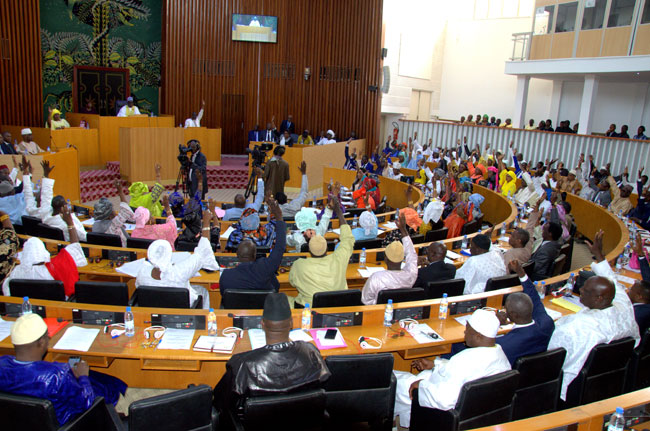
Senegal’s National Assembly on Wednesday passed a law significantly strengthening penalties for same-sex relations. Under the new legislation, such acts are now punishable by five to ten years in prison—double the previous penalties. The bill still needs to be promulgated by President Bassirou Diomaye Faye, which would make the country one of the most repressive in Africa toward LGBT+ people.
Adopted after a full day of debate by 135 votes in favor, none against, and three abstentions, the law also introduces heavy fines ranging from 2 to 10 million CFA francs (about €3,048 to €15,244), compared with the previous range of 100,000 to 1.5 million CFA francs. It also establishes criminal penalties for, among other things, the promotion of homosexuality. The maximum sentence will be applied when the act involves a minor.
The text nevertheless includes a provision aimed at punishing any malicious and bad-faith reporting of individuals accused of homosexuality.
The vote comes amid particularly tense public debate on the issue in Senegal, a predominantly Muslim country where homosexuality is widely rejected by public opinion. The controversy intensified in early February following the arrest of twelve men, including two local celebrities, accused of “acts against nature,” a legal expression used to refer to same-sex relations.
Since then, local media have reported a wave of arrests, sometimes numbering in the dozens. Some detainees are also accused of intentionally transmitting HIV, fueling heated public debate. Several human rights organizations have condemned the arrests.
In parliament, some lawmakers strongly supported the tougher legislation. “Homosexuals will no longer breathe in this country. Homosexuals will no longer have freedom of expression in this country,” declared MP Diaraye Bâ, drawing applause from part of the chamber. Representing the government, Interior Minister Mouhamadou Bamba Cissé welcomed what he called a “good law.”
For several years, influential religious groups have been calling for stronger repression of homosexuality, which they consider a deviation. The promise of tougher measures has long been part of the ruling camp’s political agenda and remains popular in the country. Homosexuality is also frequently denounced as a tool used by Western countries to impose values seen as foreign to local culture.
“Senegal is a country open to the world. But this openness cannot justify abandoning our values,” the interior minister said.
Despite the harsher penalties, the legal classification of homosexuality remains that of a “misdemeanor” rather than a crime. Prime Minister Ousmane Sonko argued that this was sufficient to achieve the government’s objective. “It allows us to obtain what we want—and even more,” he said.
However, the stance has drawn criticism from the opposition and some activists, who accuse him of failing to keep his campaign promise to classify homosexuality as a crime. “You are pursuing a policy based on lies. I will not vote for this law because it is a law of deception,” opposition MP Thierno Alassane said.
Senegal’s move comes in a broader African context where homosexuality remains widely criminalized: more than half of the continent’s countries ban it. In some states, such as Uganda, Mauritania, and Somalia, same-sex relations can be punishable by death, while around ten other countries impose prison sentences ranging from ten years to life imprisonment, including Sudan, Kenya, Tanzania, and Sierra Leone.