
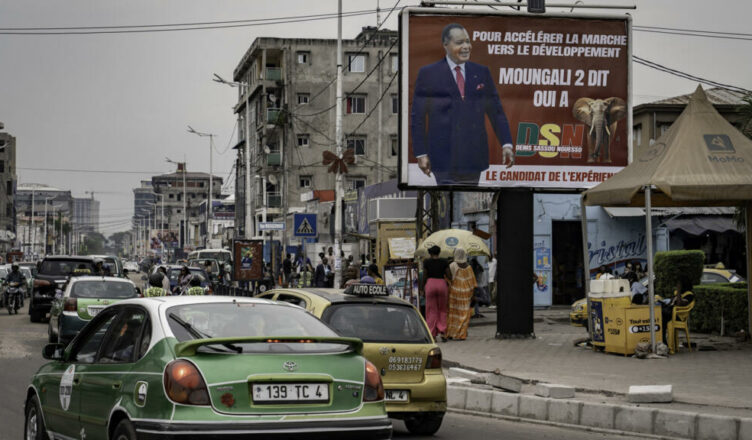
As the presidential election of March 15 approaches, in which the octogenarian Denis Sassou Nguesso—who has been in power for more than forty years in total—is seeking another term, here are five key elements to understand Congo-Brazzaville, a Central African country rich in resources but facing significant economic and social challenges, according to AFP.
The third-largest oil producer in Sub-Saharan Africa after Nigeria and Angola, the Congo—often called Congo-Brazzaville to distinguish it from the Democratic Republic of the Congo (DRC)—began producing liquefied natural gas (LNG) in 2024, mainly for export. At the beginning of 2025, the government set a target of reaching production of 500,000 barrels of oil equivalent per day within three years. Oil remains the pillar of the national economy: it accounts for about half of GDP and nearly 80% of exports, according to the World Bank. Despite this wealth, nearly one in two residents lives below the poverty line.
Since gaining independence from France in 1960, the country has experienced several coups and episodes of civil war. In 1969, a coup established the “People’s Republic of the Congo,” a Marxist-Leninist single-party regime led by the Congolese Labour Party (PCT), aligned with the Soviet bloc. After the collapse of the USSR, the country adopted a multiparty system in 1992 and resumed the name Republic of the Congo.
Although France’s economic influence has gradually declined, it remains one of the main foreign investors, alongside China. At the same time, Brazzaville maintains close relations with Russia, a partnership historically focused on military training and education, and now expanded to sectors such as energy, particularly through oil infrastructure projects.
With around six million inhabitants, the Congo is one of the least densely populated countries in Africa. More than half the population lives in the country’s two largest cities: Brazzaville, the capital, and Pointe-Noire, the main economic hub. The population is very young, with nearly one in two residents under the age of 18. Access to electricity remains highly unequal: about 67% of urban residents benefit from it, compared with just over 12% in rural areas.
The Congo hosts part of the Congo Basin, the second-largest tropical forest in the world after the Amazon. This vast ecosystem, shared with five other Central African countries, plays a crucial role in regulating the global climate and contains exceptional biodiversity. Nouabalé-Ndoki National Park, a UNESCO World Heritage site, protects populations of elephants and gorillas. However, deforestation is increasing: according to the World Bank, forest loss in the region nearly doubled between 2010 and 2020, mainly due to agricultural expansion and infrastructure development.